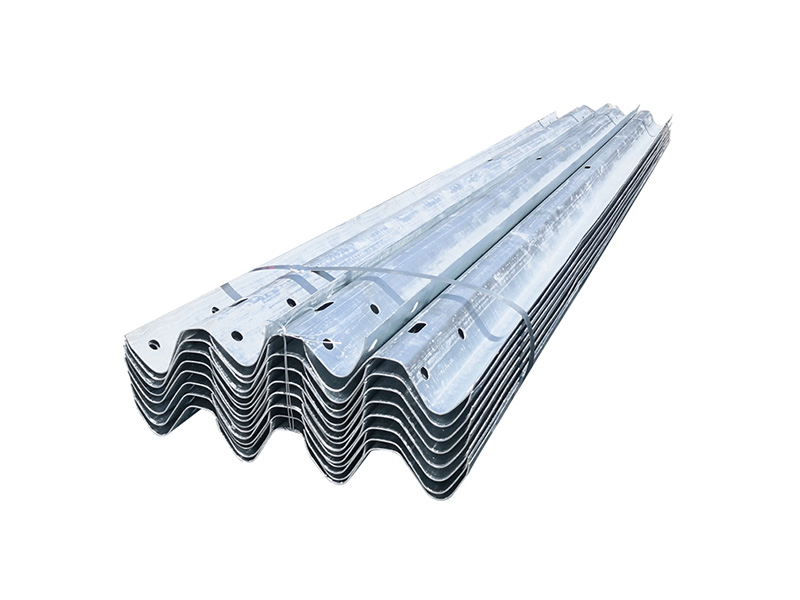
When it comes to highway construction in the United States, AASHTO (American Association of State Highway and Transportation Officials) standards are indispensable. Serving as the universal rulebook for U.S. highway engineering, they specify clear technical requirements for every component—from a single corrugated steel plate for highway guardrails to the design and construction of bridges.
AASHTO was created to address the practical needs of U.S. highway development. As a federal republic, the United States once granted states extensive autonomy in highway construction. Inconsistent design codes, material standards, and construction practices created barriers to interstate highway connectivity, driving up costs, producing uneven quality, and compromising traffic safety. To resolve these regional inconsistencies, leading state highway and transportation officials established AASHTO to develop unified industry standards. Starting with basic specifications for highway materials and simple facilities, AASHTO has evolved into a comprehensive system covering bridges, guardrails, pavements, traffic control devices, and all other highway engineering domains. Grounded in the three core principles of safety, functionality, and suitability, it provides clear guidance for every stage of highway construction.
Unlike highly theoretical industry standards, AASHTO’s most distinctive feature is its strong field applicability. It avoids unrealistic technical specifications and instead adopts detailed, scenario-based classifications tailored to regional, traffic, and functional differences. For highway guardrails—a fundamental safety feature—AASHTO defines corrosion-resistance grades matched to environmental conditions: standard galvanized coatings or high-corrosion-resistant steels for coastal high-salt-mist areas, inland dry regions, and industrial zones. It also classifies structural strength based on traffic volume and vehicle mix, setting distinct requirements for urban arterials, rural roads, and freeways. This approach ensures safety while eliminating material waste, delivering truly customized solutions.
AASHTO enforces quantifiable, unambiguous technical requirements with rigorous precision. For guardrail steel beams, minimum yield strength is specified at 345 MPa and minimum tensile strength at 483 MPa. It even provides correction factors for galvanized coating thickness when measuring steel plate dimensions. Coating adhesion is verified using practical field tests: a sharp tool is used to cut and pry the coating, which passes if no delamination or base-metal exposure occurs. On-site crews follow step-by-step procedures rather than relying on subjective judgment.
AASHTO also prescribes exact dimensions for the two standard guardrail profiles: W-beam and Thrie-beam. Curved guardrails for horizontal curves of 46 meters radius or less must be shop-fabricated and delivered to the site; only minor drilling and cutting are permitted in the field to minimize dimensional errors. Fasteners must be button-head bolts with oval shoulders to reduce protrusions and prevent secondary impact damage to vehicles. Corrosion protection for bolts, nuts, and washers is specified by guardrail type to ensure structural integrity and service life.
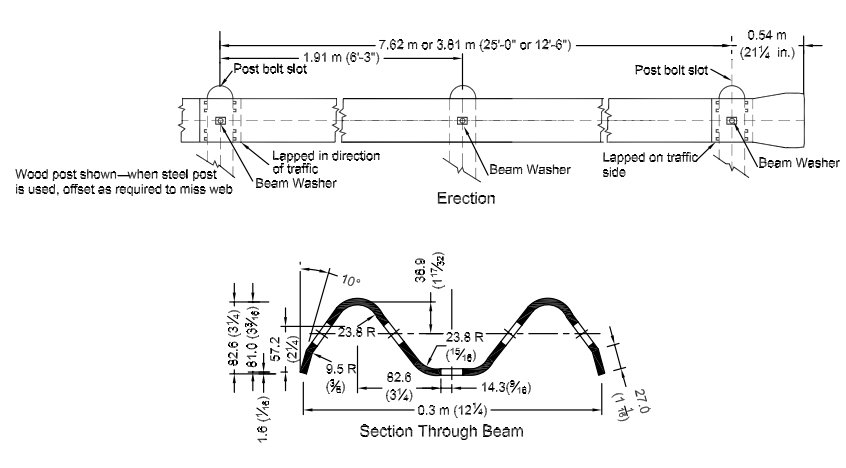
Furthermore, AASHTO is an open, collaborative system integrated with leading U.S. technical standards. It references standards from ASTM International (formerly American Society for Testing and Materials) and the American National Standards Institute (ANSI). For instance, under M 180-00 (2004), bolts and nuts must meet ASTM strength requirements, thread dimensions follow ANSI specifications, and touch-up paint for galvanizing complies with military standards. This integration creates a fully closed compliance loop, eliminating mismatches between guardrails and hardware. AASHTO adopts the International System of Units (SI) as its primary unit system while retaining inch-pound units, balancing U.S. customary practice with global compatibility. As a result, its core principles and technical metrics are widely adopted by countries and regions worldwide.
AASHTO strikes a balanced approach to quality assurance, combining strictness and flexibility. It employs a multi-tiered acceptance system: new and low-volume products undergo rigorous sampling and inspection with defined ratios and acceptance criteria to prevent nonconforming materials from entering projects. Established manufacturers with proven quality systems may qualify for certification programs that waive redundant testing, reducing inspection costs and accelerating project delivery. This framework safeguards quality while aligning with real-world market dynamics, making standards an enabler rather than a constraint for industry progress.
Beyond technical specifications, AASHTO embeds life-cycle management into highway infrastructure. It requires permanent, legible markings on all highway components showing manufacturer identification, lot number, and standard designation. Marking locations are chosen for traceability and safety—visible after installation without impeding traffic. This requirement enables full traceability from manufacturing, transport, and installation to long-term maintenance, allowing rapid root-cause analysis and resolution of quality issues. Safety is thus ensured not only during construction but throughout the service life of the highway.
As highway engineering advances, AASHTO standards continue to evolve, adapting to emerging trends such as electric vehicle charging infrastructure, connected and automated vehicle support, and sustainable materials.
At its core, AASHTO is more than a set of technical specifications—it embodies a highway development philosophy: demand-driven, safety-focused, and detail-supported, with standards that serve projects and road users alike. Using straightforward, practical language, it underpins the safety and efficiency of the U.S. highway network. It demonstrates that strong industry standards are not restrictive rules but foundational drivers of standardized, high-quality development. This is why AASHTO remains a highly influential force in global highway engineering after decades of use.


admin@jiantraffic.com
+86-06358219188
8613906350752
Guanxian Economic Development Zone , Liaocheng City, Shandong Province,China
 English
 Russian
 French
 Spanish
 Portuguese
 Arabic
 Malay
Malay Hindi
Hindi